
Published June 1, 2026
Raleigh Schools Guide | Breaking Down Most Confusing Areas

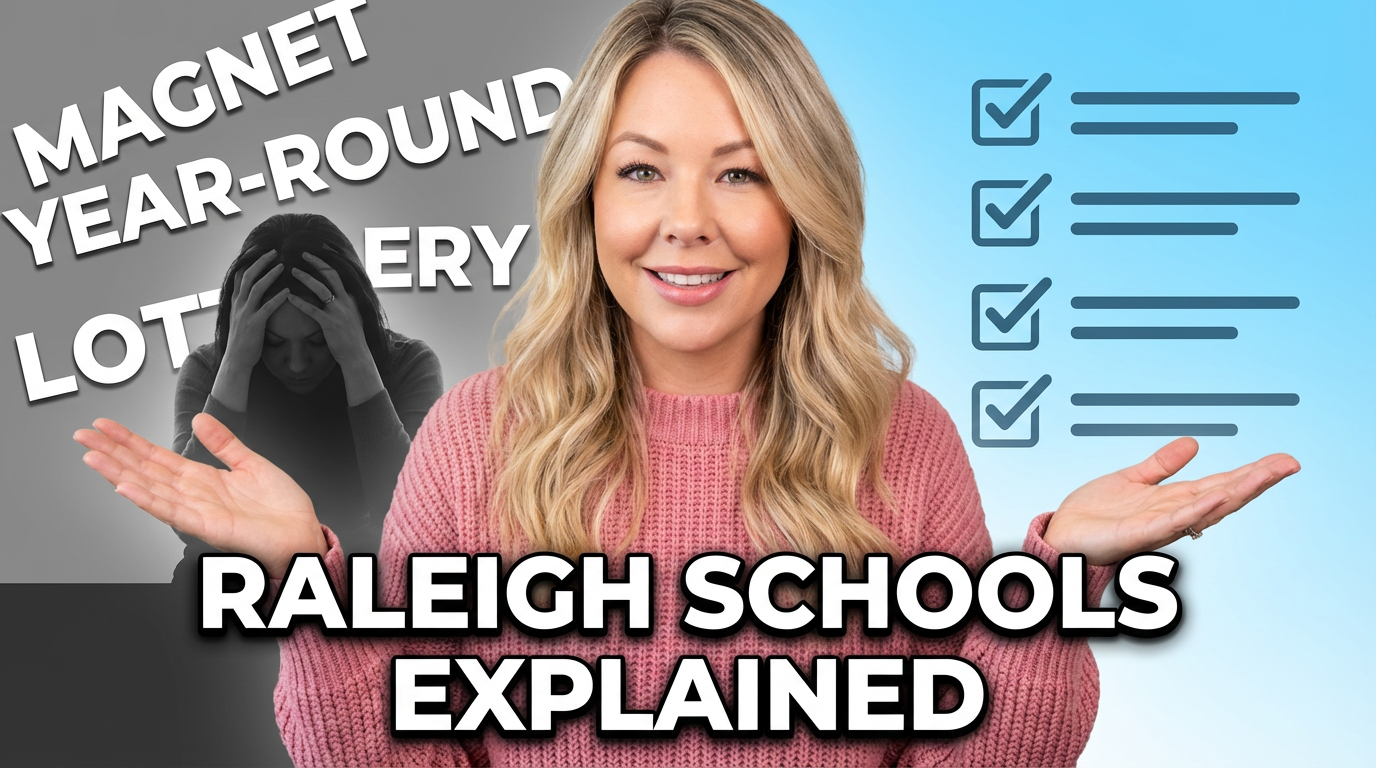
A Relocating Parent's Guide to Wake County Schools
Thinking about moving to the Raleigh area and feeling lost trying to figure out the school system? You're not alone — it's notoriously confusing. Public, private, charter, magnet, capping… what does it all actually mean for your family? It's enough to overwhelm any rising-kindergarten parent or newcomer trying to do right by their kids.
As a parent of three young kids, I've already navigated public, private, and charter schools across both traditional and year-round calendars — so this comes from real, in-the-thick-of-it experience. The goal here is to simplify all of it for anyone going through it for the first time. You can also watch the full walkthrough here: A Relocating Parent's Guide to Wake County Schools (YouTube).
The Big Picture: It's a County-Wide System
First, one of the most important — and often surprising — facts. When you move to Raleigh, Cary, or Wake Forest, you are not enrolling in a city school district. You're enrolling in the Wake County Public School System (WCPSS).
This is a massive, county-wide district — the largest in North Carolina — serving over 161,000 students across about 203 schools and counting. And it's not just big; it's highly regarded. Many Wake County schools consistently rank among the highest-rated in the state, and student proficiency in core subjects like math and reading generally runs above the state average. So right off the bat, you can rest assured the overall quality of public education here is excellent.
The challenge isn't finding a good school — it's understanding the type of school and the process to get into it. With that foundation laid, let's break down your three main pathways: public, charter, and private.
Your Three Main Choices
Every family in Wake County has access to these three categories, each with a different funding model, curriculum style, and enrollment process. This is where most of the confusion kicks in, but it's straightforward once you see it laid out.
Public Schools: The Foundation
The default and most common option. The vast majority of Wake County students attend public schools, which are funded by tax dollars, so there's no tuition. Every residential address is assigned to a specific elementary, middle, and high school — this is your "base school," your guaranteed spot.
One of the first things you'll hear about is the two calendar types:
- Traditional Calendar — what most of us grew up with: school starts in late August, with a long summer break and shorter winter and spring breaks.
- Year-Round Calendar — introduced to manage Wake County's explosive growth. Instead of a long summer, the year is split into nine-week quarters with three-week breaks between them, and students advance to the next grade in early July.
On a year-round calendar, students are placed on one of four "tracks," staggered so that one track is always on its three-week break (known as being "tracked out"). This lets a single building serve more students throughout the year. Each school runs either traditional or year-round — not both — so you're tied to whatever your school uses unless you apply elsewhere (more on that below). Note that all high schools run on a traditional calendar.
My own kids are currently year-round, and it has genuine pros and cons. It fits one of my kids better than the others, but they all really appreciate the breaks throughout the year. Some tracks are more popular than others — Track 1 is typically closest to a traditional calendar, with a solid four weeks off in June and most of December. You can request a track and schools try to honor it, but it's not guaranteed.
One big perk of WCPSS is its large offering of magnet schools, with specializations like global studies, Spanish immersion, gifted and talented, STEM, and entrepreneurship. These can be your base school by address, or you can apply to them (more below).
The key takeaway: you're guaranteed a spot at a high-quality school based on your address. You just need to know which school that is and what calendar it follows.
Charter Schools: The Public Alternative
There's a lot of misunderstanding here, so the most important thing to know is that charter schools are public schools — publicly funded and 100% tuition-free. The difference is that they operate independently from the main district, which gives them more flexibility in curriculum, teaching methods, and culture. Many have a specific focus like STEM, the arts, or character-building, which appeals to families wanting a different take on education.
That said, charter students take the same End-of-Grade tests as traditional public school students, so the material has many similarities. Charters often have smaller class sizes and a strong sense of community and parent involvement. On a common question — college acceptance rates for charter versus traditional public schools — there really isn't a meaningful correlation either way, so I wouldn't base your decision on that.
So what's the catch? It's how you get in. Admission isn't based on your address — it's based on a random lottery. You submit an online application, typically October through January (though every school is unique, so check their website), and find out a month or two later. Most parents apply to three or four schools, sometimes more, to improve their odds. You'll likely land on waitlists for most of them, but because so many families apply and later drop, you'd be surprised how many kids get in from far down the list.
A few more notes: siblings aren't guaranteed spots, but most schools offer priority if a sibling already attends, and families are usually successful in keeping kids together. Most charters don't offer transportation, and sports are hit or miss. Bottom line: charters are an excellent choice for many families, but they come with extra hoops and a wide variety of experiences.
Private Schools: The Independent Path
Your third option is the only path completely separate from the public system. Private schools are funded by tuition, not tax dollars, and run their own admissions. In North Carolina, they don't require annual state End-of-Grade testing, but they do administer a nationally based test in grades 3, 6, 9, and 11.
The Raleigh area has a huge variety. About half have a religious affiliation — most commonly Christian or Catholic — but there are also many excellent non-sectarian, college-preparatory schools. Names like Ravenscroft, Cardinal Gibbons, and The Raleigh School are well-known for rigorous academics, small class sizes, and extensive programs.
That independence comes with a price tag. Average private tuition in Raleigh runs around $15,000 a year, but that's just an average — well-known prep schools range from the high teens to over $30,000. Elementary and middle schools are often well below the average, while private high schools really climb.
Student Support, Special Education & Homeschooling
One important comparison: both public and charter schools are required by law to provide special education programs and specific interventions, though the strength varies by school, so do your research. (On a personal note, I've been very happy with the support at our kids' elementary school.) Private schools are a mixed bag — they're not legally required to accommodate these needs, so while some do it well, others are far less equipped.
There's also a large homeschooling population in Wake County. The county provides some general assistance through certain programs, but homeschool students largely follow their own private curriculum and are required to take a national end-of-year test. The community is fantastic, with plenty of options for small-group learning and even sports teams homeschoolers can join.
If you need personalized, in-depth guidance, I'm happy to recommend great education consultants. My expertise is real estate — and specifically what a given home means for the schools your kids will be assigned to.
Navigating the WCPSS Labyrinth
Now for the specifics that cause relocating families the most anxiety: magnet schools, capping, and overflow.
Magnet & Early College: The Application Maze
Magnet schools are public schools with specialized programs — they operate like any other school but offer different electives and curriculum students can opt into. There are also early college programs, among others. Getting in works much like a charter: typically a lottery application. But here's the part that trips almost everyone up:
You must first enroll your child in WCPSS before you can apply for a magnet lottery.
Your base school assignment is your ticket to apply for other public options. You can't skip that step — you enroll at your base school to get your student ID number, then enter the lottery for the magnet program you want. If you win a spot, that magnet school becomes your child's new assigned school; if not, you simply stay at your base school. Always check the official WCPSS website, since rules and priorities can change year to year, but the application window is typically October through mid-January.
"My School Is Capped!" — Capping and Overflow
The most frustrating and least understood scenario for relocating families is capped schools. Many people buy a home because of a certain school — but if you don't check the Capped List on the WCPSS website first, you could be in for an unwelcome surprise.
So what is a capped school? Wake County is growing so fast that some neighborhood schools become physically full. When that happens, the school board "caps" enrollment for new students moving into the area to prevent overcrowding. Your child is then assigned to a nearby "overflow" school with more space. In most cases the district provides transportation there, and your child goes on a waitlist for your original base school — if a spot opens, you'll get a call and can move back.
I know that sounds stressful, but it's a common part of life in high-growth areas like West Cary or Apex. The key thing to remember: an overflow school is still an excellent WCPSS school, so your child is never left without a place. It's just a logistical shuffle to manage growth. One more note — if a school becomes capped after you've moved into the neighborhood, you can still attend, but you may need to provide proof of when you closed on your house.
Your Very First Step
We've covered a ton of ground, so here's the single thing to do right now: find your base school.
The WCPSS website has an excellent tool called the Base School Locator (or Address Lookup). Type in the address of a home you're considering, and it instantly tells you the assigned base elementary, middle, and high school for that specific property. Do not rely on apps like Zillow for assigned schools — I've seen the wrong info there more times than I can count.
This is your starting point and your guaranteed option. From there you can explore everything else — calendars, magnet applications, charter lotteries, private school tours — but you have to start with your base. It's the anchor for your entire school search in Wake County.
Wrapping Up
Hopefully the differences between Wake County's school types feel a lot clearer now. I know quite a bit, but I'm no expert on the schools themselves — for that, I can point you to great consultants. What I am an expert in is real estate, and especially what a given home means for the schools your kids will be assigned to. If you're buying or selling, don't hesitate to reach out.
To go deeper on the area itself, download our free Raleigh Relocation Guide here — and check out our other videos on Raleigh's suburbs and best neighborhoods. Thanks for reading!
Alison Wojnarowski
Team Owner | The W Group | LPT Realty | PLACE
or another way