
Published May 21, 2026
These Raleigh Areas Are About to Explode!

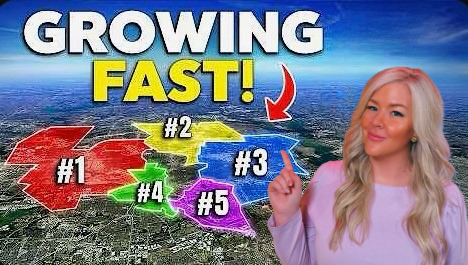
5 Raleigh-Area Corridors Poised to Explode Next
If you think the Triangle's growth story is already big, you haven't seen what's coming next.
Right now, multiple billion-dollar projects are quietly reshaping the Raleigh area at the same time. Historically, when infrastructure, high-paying jobs, and destination-style development arrive together, home values don't just rise gradually — they accelerate. And the Triangle is getting all three at once.
Below, we break down the specific corridors most likely to surge, the projects driving that growth, and why some of these areas may look completely different within a decade. The next version of Raleigh is already being built.
The Pattern Behind Every Boom
Before getting into individual hotspots, it helps to understand the larger pattern. The biggest home-value run-ups tend to happen when three forces show up together:
- Major infrastructure — new highways, transit, and connectivity
- High-paying jobs — corporate campuses and tech employers
- Destination-style development — entertainment districts, stadiums, and mixed-use hubs
The Triangle already ranks among the country's fastest-growing regions for tech workers, college-educated migration, and inbound relocation from high-cost states. Now it's entering a second phase of growth — one driven by transportation expansion, entertainment districts, and major corporate investment. One of the biggest catalysts of all is the completion of the I-540 loop.
Area 1: The Southern I-540 Corridor (Garner, Clayton & Southern Wake)
One of the biggest future-appreciation corridors in the Triangle sits along the new southern I-540 expansion — especially near southeast Raleigh, Garner, Clayton, and southern Wake County.
The completion of the Southern Wake Expressway fundamentally changes regional connectivity. For decades, many of these areas felt too disconnected from Research Triangle Park and western Wake County, creating long, illogical commutes. The new 540 segments erase that barrier. Suddenly Clayton is dramatically more connected to RTP, and southern Wake County becomes far more attractive to commuters.
When commute times shrink, land values usually rise. We saw exactly this in North Raleigh, Cary, and Apex after earlier expansions of the same roadway — density filled in rapidly, and homes just outside the new outer loop nearly doubled in value over about a decade.
Now the same pattern is moving south and east, and the upside here is simple: there's still land — a lot of it. Compared with Cary or North Raleigh, much of Clayton and southern Wake County still offers lower prices, larger lots, and substantial undeveloped acreage. That combination becomes powerful once highway access improves, and the market is already reacting. Developers are aggressively targeting Clayton, Garner, and southeast Wake County for large-scale residential growth. Once a full outer loop exists, suburban expansion accelerates outward — and that's typically when appreciation starts compounding.
Area 2: Downtown South
Downtown South may become the biggest urban transformation project in Raleigh. Located just south of downtown near South Saunders Street and I-40, it's planned as a massive mixed-use entertainment district. The vision includes high-rise residential and office buildings, entertainment venues, retail, restaurants — and potentially a soccer stadium.
This matters enormously for nearby real estate, because large mixed-use districts create ripple effects outward from the project itself. Look at what happened around The Battery in Atlanta, Nashville's Gulch, or NoDa in Charlotte: once entertainment, walkability, nightlife, and new housing arrive, surrounding neighborhoods often see major reinvestment.
South Raleigh is still relatively undervalued compared with North Hills, Downtown Cary, or North Raleigh — and that gap creates opportunity. This could be the start of "the next North Hills" and a reinvention of an area that has historically been very commercial. Keep an eye on the corridors around South Saunders, Tryon Road, Lake Wheeler, and south-central Raleigh. Once major private investment enters an overlooked area, perception changes quickly — and shifting perception drives some of the biggest appreciation cycles in urban real estate.
Area 3: Apple's RTP Campus
This may be the project with the single biggest long-term impact on Triangle home values. Even before full buildout, Apple's announcement has already accelerated growth pressure across Cary, Morrisville, western Raleigh, and Apex.
Apple isn't just one company — it's a signal that the Triangle is becoming a top-tier national tech hub. When Apple enters a market, housing demand follows, especially from engineers, executives, startup founders, and highly paid remote workers. The areas closest to RTP stand to benefit most: western Cary, Morrisville, northwest Apex, Brier Creek, and the west Raleigh corridors near I-540.
Here's the underlying driver. The Triangle is still dramatically cheaper than Silicon Valley, Seattle, Boston, or Northern Virginia — a dynamic economists call migration arbitrage. Highly paid workers relocate from expensive markets and buy substantially larger homes here. That demand has already pushed premium Cary neighborhoods into million-dollar-average territory.
Expect northwest Cary to keep getting more expensive, with the next appreciation wave likely landing in adjacent, still-cheaper areas — especially western Apex and outer Cary growth corridors connected by 540. Notably, the Apple campus delay has temporarily delayed the price surge too, which creates a window of opportunity for buyers who want to get in before they're priced out.
Area 4: The Lenovo Center District
One of the most overlooked growth stories is happening around the Lenovo Center (formerly PNC Arena). The area surrounding the arena is now planned for a massive sports-and-entertainment district potentially worth more than $1 billion, including thousands of apartments, entertainment venues, hotels, restaurants, office space, retail, and high-rise development reaching up to 40 stories.
This is a big deal. For years, one of the most common criticisms of the arena was that it lacked surrounding urban development — fans regularly point out how isolated it feels compared with Charlotte's downtown districts. It's been great for tailgating, but where does everyone actually eat before a Canes game? This project changes that, with ambitions on the scale of The Battery outside Atlanta, which transformed its surroundings.
When large entertainment districts emerge, adjacent neighborhoods often appreciate significantly — here that means west Raleigh, Edwards Mill, Trinity Road, the Blue Ridge corridor, and areas near NC State. The reason is straightforward: districts like this generate nightlife, walkability, destination traffic, tourism, and higher land demand.
The numbers are already substantial. The Lenovo Center hosts over 150 events a year, attracts more than 1.5 million visitors annually, and generates over $200 million in economic impact. Now layer in housing, retail, offices, and a true mixed-use district around that activity. That's the kind of transformation that can reshape an entire side of a city — in 15 years, you may not recognize the area.
Area 5: Holly Springs
Finally, Holly Springs may be entering the exact growth phase Apex experienced years ago. For a long time, Apex was considered "the next Cary." Now many believe Holly Springs is becoming "the next Apex."
Nearby 540 connectivity is accelerating that process, alongside the groundbreaking of Veridea, a roughly $3 billion development in western Apex. Holly Springs already benefits from strong schools, biotech expansion, suburban quality of life, and major population growth — but accessibility historically limited some of its potential. That's changing quickly as commuters can now move around the Triangle more efficiently, with some easing of US-1 and Hwy 55 traffic.
Because Holly Springs still offers developable land, newer housing, and lower prices than Cary, many buyers originally targeting Cary and Apex — including well-paid RTP tech workers — are increasingly looking here to avoid the premiums next door. Historically, when affluent buyers spill from one booming suburb into the next adjacent one, that secondary suburb often enters a major appreciation cycle. That's exactly what could happen next in Holly Springs — and arguably has already started.
What's Next
What's happening in Raleigh right now isn't random growth. The question isn't if these transformations happen — it's which one explodes first.
If you're looking to build wealth, all five of these corridors present real opportunities. If you'd like help putting a strategy together, our team would love to talk — and be sure to grab our free relocation guide to dig deeper and check out our YouTube video today!

Alison Wojnarowski
Team Owner | The W Group | LPT Realty | PLACE
or another way